Pages

Tuesday, 26 May 2015

Register Your Vehicle

     
  1. After waiting for our vehicle for many months, we want it to be registered as soon as possible. We will not blame the vehicle dealer for the months of waiting, but will blame JPJ even for one day delay in registering our vehicle. Therefore, JPJ has to come out with a complete environment of various online systems to make vehicle registration smoother and faster, while protecting the data integrity.
     

  1. These various online systems are just to deal with a vehicle’s early life part. There are many more online systems that a vehicle has to deal with in its whole life cycle. Take the current best selling car (Perodua Axia) as an example of vehicle registration using these online systems:

  1. NIK (Nombor Identifikasi Kenderaan – Vehicle Identification Number)
    • Perodua as the car manufacturer will send NIK to JPJ to ensure that the Axia when going to be registered later is a genuine Axia manufactured by Perodua.
    • Hence, buyer can rest assured that the Axia they bought is not a clone made by some Tom, Dick or Harry at their backyard.
    • Note: For imported vehicles, the system is known as NIKi (Nombor Identifikasi Kenderaan Import).

  2. eEksais
  • Royal Malaysian Customs Department will send excise duty payment data to ensure that the Axia has already settled its tax.
  • Hence, the Government will not be duped by fake customs’ forms anymore and losing millions in tax collection.
  • Note: For imported vehicles, Ministry of International Trade and Industry (MITI) will also send approved permit data using eAP system.

  1. eDaftar
    • After a buyer confirmed to buy an Axia, Perodua sales dealer will send all car and owner data to JPJ through Perodua’s eDaftar system.
    • Therefore, the use of paper form are eliminated and JPJ staffs will not have to key in back all those particulars contained in paper forms anymore.

  2. eInsurans
    • Insurance agent or insurance company will send the Axia’s insurance data with open date to JPJ to ensure that the Axia is covered by genuine insurance policy.
    • There are three gateways which link all insurance companies to JPJ.
    • Therefore, the use of physical insurance cover note is eliminated and JPJ staff will not have to key in back all those particulars contained in the cover note or verify dubious cover note with insurance companies anymore.
    • Car owner will not be cheated by paying for fraudulent insurance which is not from insurance companies.

  3. eHakmilik
    • After the loan for the Axia has been approved, the bank will send ownership claim data to JPJ.
    • There are two gateways which link all banks and financial institutions with JPJ.
    • Therefore, JPJ will not have to key in and keep the physical ownership claim letter anymore. Furthermore later, ownership claim can be cancelled at any JPJ branch.
    • Banks and financial institutions will not be cheated on ownership cancellation by faking the claim letter. 

  4. ePuspakom
  • If the Axia is going to be registered using an interchange registration number, Puspakom will send the other vehicle’s inspection data to JPJ.
  • Hence, JPJ will not be duped by fake inspection certificate (usually of non-existent vehicle) and Puspakom will reduce the risk of losing fee collected.
  • This system is also used for all types of inspection such as imported vehicles and transfer ownership inspections.

  1. MySikap Registration System
    • All above data will be matched automatically upon registration. JPJ will print registration card (grant) and vehicle licence (road tax) immediately.

  1. Therefore, blame vehicle manufacturer/importer and its dealer if you receive your car late :)

Tuesday, 12 May 2015

Core Problem in Developing MySikap


  1. MySikap is JPJ new computer system replacing Sikap. It is the backbone of JPJ Transformation Programme. Now it can be considered as a successful computer system. However, developing MySikap was not a smooth sail.

  2. Normally in developing a computer system, developers will apply systems development life cycle (SDLC) which comprises of five phases which are planning, analysis, design, implementation, and support and security (Vermaat, Sebok, Freund, Campbell, & Frydenberg, 2015).


  1. MySikap project was tendered out in 2006 (actually it was named MySikap only in 2012), but only in 2010 the developer was selected. There were many technological and requirement changes during the 4 years gap, even the old Sikap has undergone many changes from 2006 to 2010 to cater for the latest needs. Therefore, JPJ has to redo the analysis phase aka user requirement specification. This phase was largely an exciting phase.

  2. But problems started with the transition from analysis to design phase. Normally for other computer system projects, the business analysts for the two phases are the same people to ensure continuity. However in MySikap project, the business analysts who work in the design phase were not involved in the analysis phase.


  1. Looking at the real example above, can you at least design the interface? You just cannot as you were not involved in the analysis phase. 

According to Vermaat et. al. (2015), “In theory, the five system development phases often appear SEQUENTIALLY”. “In reality, activities within adjacent phases often INTERACT with one another, making system development a dynamic, iterative process”. (Emphasis are mine).

The too sequentially process that did not interact made the business analysts’ knowledge lost in between the analysis and design phase.

  1. The business analysts from design phase can always refer to business analysts from analysis phase, but might as well the same business analysts do them. It was only over a year after user requirement specification document was completed that JPJ can first see the interface design, after many interventions.

  2. This is where the problems started that MySikap was not able to meet its various deadlines. Many serious problems later occurred due to rushed implementations.

     
    (Source: Google Images)
    (Source: Google Images)

    (Source: Google Images)

    (Source: Google Images)
  3. Meanwhile, Axiata also faced its own problems in its computer transformation programme.


  1. Hopefully with these sharings, nobody either government or private sector will repeat those same mistakes.

Tuesday, 28 April 2015

Invention, Innovation & Design Exposition (iidex) 2015


We went to iidex 2015 today (28th April 2015) held at DATC, UiTM as instructed by our MIS750 lecturer Assoc. Prof. Dr. Norzaidi Haji Mohd Daud. There were various IT related products that were exhibited apart from other types of inventions.

An application that really attracts my attention was Arabic-Malay Cognates As A Computer Assisted Language Learning developed by Roaya Shehab. Although if I am not mistaken the system did not win any prize in iidex 2015.

http://ieeexplore.ieee.org/xpl/articleDetails.jsp?arnumber=7076891&punumber%3D7076841%26filter%3DAND(p_IS_Number%3A7076851)%26pageNumber%3D2 
 

According to the developer, there is about 3,000 Malay words which are similar in pronunciation and meaning (cognates) with Arabic words. This is not surprising as every language actually loans words from other languages. As in Malay language case, among others, it loans words from Sanskrit, Arab, Portuguese, and English languages. Therefore using this application, learning Arabic language by a person proficient in Malay can be made easier as there is about 3,000 words readily recognizable.

A user can key in or copy a whole Arabic sentence and the application can recognize the cognates. The application also calculates similarities (in percentages) of the Malay-Arabic cognates. For example, the word ‘bank’ has 100% similarities while the word ‘zirafah’ has 57% similarities.


Although the Malay-Arabic cognates is not new, but using an application to recognize the cognates in a sentence is important as Malay speakers sometimes come across these words when reading the Quran and need to understand them. Usually, a proficient Malay speaker can only recognize words originated from English as English is a second language in Malaysia. Words originated from Sanskrit and Portuguese are the hardest to recognize as these languages are not the lingua francas anymore and I believe that almost all Malay speakers do not really care the origin of those words as almost all of them are not linguists.

However, I found out that many other words should be included. For example, the singular word ‘haiwan’ is included, but the plural ‘hayawan’ is not. Although there is a feature that a user can use to key in words, but I think only the system administrator should be allowed to include cognates. The feature for the user should be changed to suggest word(s) to the administrator.

Tuesday, 14 April 2015

ePetrol: Fuel Price Subsidy Management System

(Source: paultan.org)
 
  1. Due to relatively low global crude oil prices, starting 1st December 2014, the Government saw that there was no more significant benefit of subsidizing fuel price for motorists. However, as oil global crude oil prices is actually volatile, it was unclear whether fuel price subsidy will be discontinued for good or will be reinstated back when the global crude oil prices rise again in the future.

Hasan Malek: No more RON95 petrol, diesel subsidies from Dec 1 (21 November 2014)

  1. Before that announcement, when the Government was still giving fuel price subsidy, the Government also has announced about three tiers of fuel price subsidy recipients. However, how actually the fuel price subsidy mechanism is going to be implemented was unclear as well.

Petrol subsidy rationalisation system using MyKad being studied, says Ahmad Maslan (23 October 2014)

Full fuel subsidy only for those earning under RM5,000 monthly (27 October 2014)

Najib: New RON95 petrol subsidy scheme to take effect mid-2015, diesel earlier (30 October 2014)

Following those announcements, some oil companies in Malaysia such as Caltex have taken pro-active measure to inform their customers, but I believe they are also in the dark about the actual mechanism.


  1. The proposal of a computer system to manage fuel price subsidy given to the motorists has been around for quite some time since 2008.

ePetrol: Possible Fuel Subsidy Control Mechanism? (21 May 2008)

ePetrol for Fuel Subsidy Management? (22 November 2009)

  1. The proposed system probably will utilize MyKad and link-up with Inland Revenue Board (IRB) for recipients’ identification and fuel subsidy quota. However, I hope the Government will not opt for such system as experience proved that it will burden the Government and the people more than it should assist. 

  2. Possible repercussions are:

  1. Linkup mechanism with IRB
  • The link-up mechanism with (possibly) IRB to obtain income and monthly quota data is still unclear whether will be verified before every fuelling transaction (data on IRB server) or will be uploaded annually onto MyKad (data in MyKad chip).
  • If the data is going to be verified before every fuelling transaction (such as credit card approval):
  • Time for fuelling will be longer as verification time is dependent on the Internet connection and IRB server.
  • IRB database will keep the monthly quota balance.
  • If data is uploaded onto MyKad annually at IRB offices possibly after income tax declaration:
    • The month of May will be the peak month to upload income data because most of us usually will declare our income tax during April. Those previously did not declare because their income are below threshold now have to declare as well if they want to receive fuel subsidy.
    • The monthly quota (whether in litre or RM) will be written and updated onto MyKad.
    • Confirmation with National Registration Department (NRD) whether got space to write income and monthly quota data.
  • Either option will have their own complexity.

  1. MyKad reader/writer
  • If the data is going to be verified before every fuelling transaction:
    • Every petrol station even at the rural and remote areas have to obtain MyKad reader as current card reader (credit card and loyalty card) might not be compatible to read MyKad.
    • For example currently, Caltex user can only use credit card at the pump but have to update B-Card (loyalty card) at the counter. Compared to Petronas where credit card and Mesra card can be used at the kiosk.
  • If data is uploaded onto MyKad annually:
    • In addition to the same complexity as above, as write on MyKad is very different from read, a costlier MyKad reader and writer must be used by every fuel station to update monthly quota.

  1. MyKad chip
  • There are many MyKad with damaged chip due to various reasons. NRD which has no involvement in the system will be burdened by MyKad replacement although the physical card still intact. Probably NRD also will be asked to upload income and monthly quota data after every replacement.
  • The cost of MyKad is quite expensive about RM30 mainly contributed by the chip cost.
  • IRB also will be burdened with customers’ ire when the chip is damaged when using MyKad at fuel station or uploading data onto MyKad.

  1. Internet connection
  • If the Government opt for income data going to be verified before every fuelling transaction, the Internet connection especially at rural fuel stations have to be upgraded. There will be chaos if consumer cannot get their fuel subsidy when fuelling.

  1. Therefore due to its complexity, ePetrol is not a good system and the Government should not implement it. If the need come to give fuel price subsidy, the Government can easily distribute petrol voucher such as 1Malaysia Book Voucher or credit sum of money directly into eligible person bank accounts such as BR1M. Using IT may sound bombastic but it is not worth it for simple things.

Tuesday, 31 March 2015

Academic Visit to JPJ IT Division, Cyberjaya

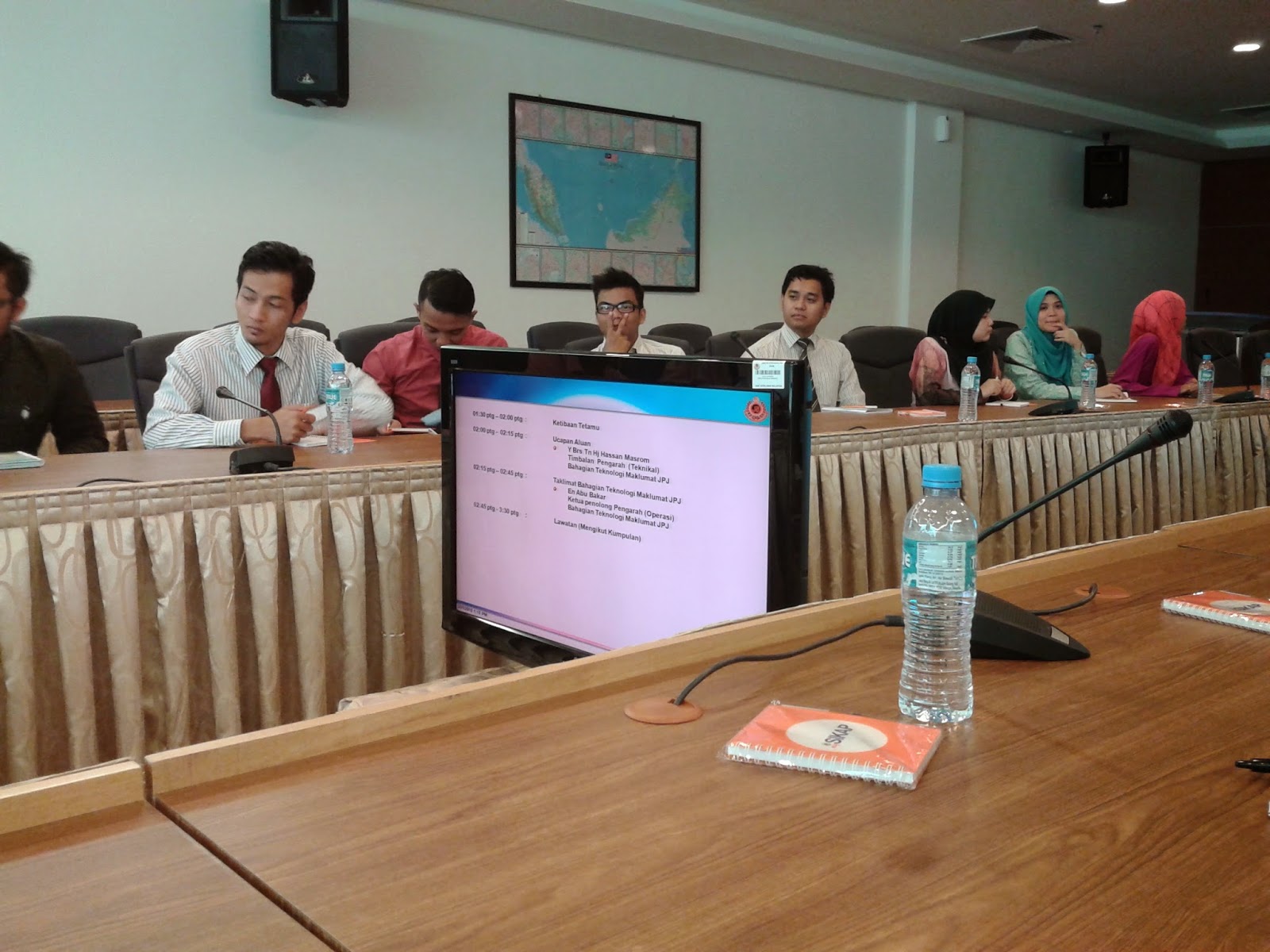
Today (31st March 2015), I had the opportunity to arrange an academic visit for MIS750 course to JPJ IT Division, Cyberjaya.

(Source: Google Images)

I have been here many times before especially for meetings and sometimes for events.

(Source: Google Images)

Can you see me smiling there? It was a visit by the Deputy Transport Minister on 31st May 2013. You can read more about it here.

Now back to our MIS750 academic visit, our delegation was led by our lecturer, Assoc. Prof. Dr. Norzaidi Haji Mohd Daud. The briefing was given by Tuan Haji Hassan Masrom, Deputy Director (Technical) JPJ IT Division.


After the briefing, our delegation proceeded to visit JPJ Data Centre. It was a very rare opportunity to be in the Data Centre. However as we are pure public university students, we were allowed into.

Sorry, no photo allowed though. But we visited this IBM zEC12 mainframe. To digress a bit, in January 2015, IBM introduced the latest z13.

(Source: Google Images)
 
Some token of appreciation from our delegation.

Group photo of JPJ IT Division and our MIS750 delegation.

Many thanks to Dato' Sri Ismail Ahmad, JPJ Director General, and Dato' Baharuddin Haji Mahammad for allowing us to visit JPJ IT Division, Cyberjaya.